

Many business owners face the choice: aggressively grow now or maintain stability until selling. What if adopting a growth mindset could let you do both — enhancing value now and making your business more attractive to prospective buyers?
Here’s what growth-focused owners do differently — and how that translates into real value at exit time.
Key Ways a Growth Mindset Adds Sale Value
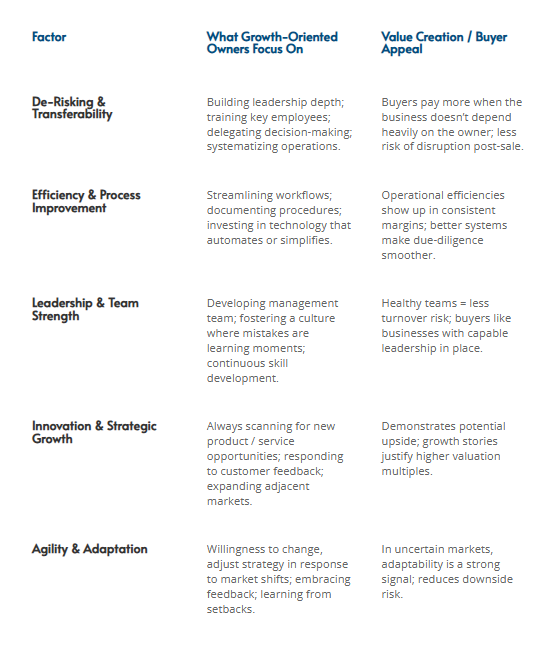
Factor
What Growth-Oriented Owners Focus On
Value Creation / Buyer Appeal
De-Risking & Transferability
Building leadership depth; training key employees; delegating decision-making; systematizing operations.
Buyers pay more when the business doesn’t depend heavily on the owner; less risk of disruption post-sale.
Efficiency & Process Improvement
Streamlining workflows; documenting procedures; investing in technology that automates or simplifies.
Operational efficiencies show up in consistent margins; better systems make due-diligence smoother.
Leadership & Team Strength
Developing management team; fostering a culture where mistakes are learning moments; continuous skill development.
Healthy teams = less turnover risk; buyers like businesses with capable leadership in place.
Innovation & Strategic Growth
Always scanning for new product / service opportunities; responding to customer feedback; expanding adjacent markets.
Demonstrates potential upside; growth stories justify higher valuation multiples.
Agility & Adaptation
Willingness to change, adjust strategy in response to market shifts; embracing feedback; learning from setbacks.
In uncertain markets, adaptability is a strong signal; reduces downside risk.
Practical Steps to Cultivate a Growth Mindset Now
1- Systematize Everything Important
Document standard operating procedures (SOPs), workflows, customer service protocols — things a buyer will want to see and rely on.
2- Measure What Matters
Track metrics beyond sales (customer retention, staff turnover, process cycle times, etc.). Use them to drive improvement.
3- Invest in People
Develop a leadership bench; ensure roles and responsibilities are clearly defined and not too owner-centric.
4- Encourage a Learning Culture
Celebrate experimentation. Accept that some initiatives will fail. Use failure as feedback.
5- Align Strategy with Vision
Create a growth plan (new markets, services, innovations) but ensure it’s realistic. Buyers will expect credible potential, not just grand ideas.

⚠️ Common Pitfalls When You Ignore Growth
- Overdependence on the owner or founder. Buyers discount heavily for that risk.
- Undefined or informal processes; operations that rely on tribal knowledge. That makes transition costly.
- Stagnant product / service lines. If everything has been “the way we’ve always done it,” that looks like declining upside.
- Culture that punishes or hides mistakes — reduces innovation, slows improvement.

What You Should Do If You Plan to Sell (or Want Higher Value Now)
- Begin with an internal “health audit”: leadership, financials, customer contracts, systems.
- Prioritize improvements that both grow value today and make sale preparation smoother later.
- Track improvements and document them — buyers will want evidence.

Sources:
- “Sell or Grow? How a Growth Mindset Adds Value” – Amp Business Valuations
- “How a Growth Mindset Matters in Business” – Business.com
- “Achieving Growth: Putting Leadership Mindsets and Behaviors into Action” – McKinsey & Company
- “80% of Companies Say Growth Mindset Among Employees Directly Drives Profits …” – Forbes
- “How to Develop a Growth vs Fixed Mindset in Business” – Keep Small Business Automation Blog